

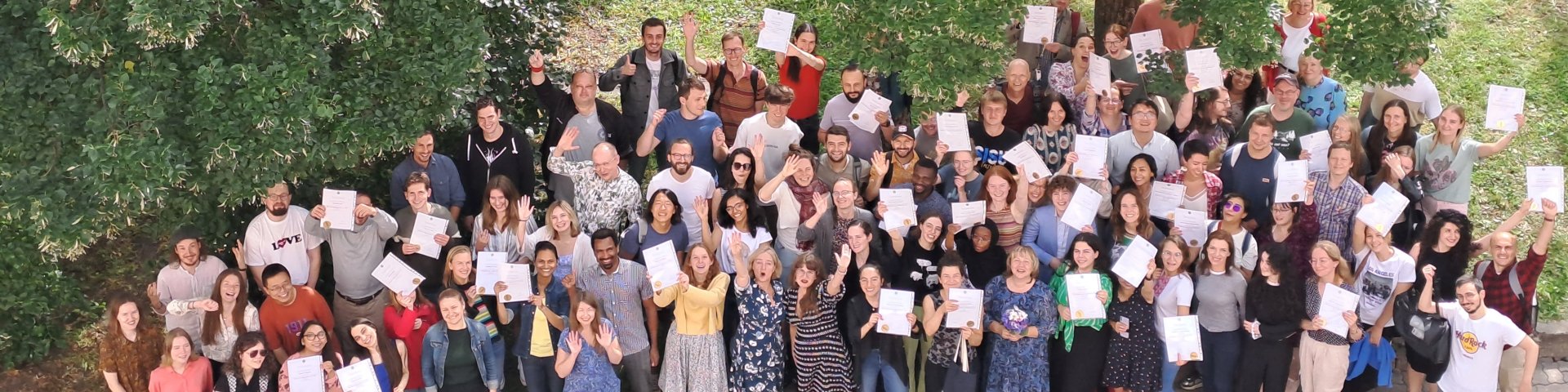
Estonian summer courses
Are you ready to immerse yourself in the Estonian language and culture this summer?
We are accepting applications for the Estonian summer courses, which will take place from 27 July to 7 August 2026 at the University of Tartu Institute of Foreign Languages and Cultures (Lossi Street 3, Tartu, Estonia). You can choose from five different language levels, ranging from beginner to advanced. Applications were due 30 April 2026.
There are five modules, each for a different language level. Each module is worth 4,5 ECTS and corresponds to 56 academic hours of language lessons. The objectives and content for each course are defined and selected in accordance with CEFR. Click on the course title below to see the general topics and grammar covered at each level.
Module I is meant for beginners who have never learned Estonian before. If you have learned Estonian before but are unsure which level to choose, don't worry. There will be a short test and interview for modules II–V on the first day to ensure everyone is in a group best suited to their needs.
The materials used in the summer school programme are all compiled by our language teachers. The coursebooks are a collection of well-chosen materials that never leave grammar alone and always pair it with practical exercises to cover all four skills: reading, writing, listening and speaking.
Vocabulary and conversation topics:
- Hello! Let's get acquainted
- I am a student
- My favourites
- In the shop and in the café
- My day
- My family
Grammar:
- Pronouns, verb conjugation in present tense
- Grammatical cases (Nominative, Genitive, Partitive)
- Semantic cases (Local cases etc)
- Constructions: Who has...? Who likes ...?
Upon completing the course, the students will be able to:
- understand and use some Estonian cases, conjugate Estonian verbs in the present, use the imperative and use adjectives and cardinal numbers;
- talk and write about themselves, their family, daily activities and food and drinks and what they like and dislike;
- understand and create elementary-level oral and written texts;
- use simple words, expressions and sentences that can be encountered in frequently occurring situations in a café, shop and market.
Vocabulary and conversation topics:
- Let’s get acquainted
- Time, daily routine
- Activities, what are you doing today, what did you do yesterday, what did you do last year
- What do you like to do, what you can do, what do you have to do
- Where are you, where are you going - different places and spaces
- Let’s describe people and things: adjectives and opposites, appearance and clothes
Grammar:
- Revision of interrogatives, personal pronouns, verbs, numbers
- Adjectives, opposites, nominative plural case
- Comparison of adjectives
- Present tense and simple past tense, ma- and da-infinitive
- Locative cases. Postpositions
Upon completing the course, the student:
- is able to conjugate Estonian verbs in the present tense and simple past tense;
- knows how to form and use locatives;
- knows how to form comparative and superlative forms of adjectives;
- is able to speak about themselves and their friends; describe different people, talk about plans and daily routine; tell what happened in the past;
- has received information about Estonia, Estonian nature, culture, people and traditions.
Vocabulary and conversation topics:
- me and Estonia
- my hobbies and free time
- education and professions
- travelling
Grammar:
- revision of past simple
- present perfect
- ma- and da-infinitive
- mine-sufix
- verbs that express movement käima
- constructions õppima kelleks?, saama kelleks?, töötama kellena?
- cases in plural
- revision of locative cases
- reading dates
- comparison of adjectives and adverbs
- conditional mood.
Upon completing the course, the students will be able to:
- speak fluently about his /her personal connection with Estonia and Estonian;
- understand and use Past Simple and Present Perfect in oral communication and written texts;
- speak and write about him / her hobbies and interests;
- speak and write about his / her studies, education, profession(s) and plans for future career;
- write his / her CV;
- understand and use Estonian cases in singular and knows the principles of forming plural cases;
- compare adjectives and most common adverbs;
- use locative cases correctly;
- speak about travelling;
- communicate in easier situations connected with travelling;
- use conditional mood;
- read dates.
Topics:
- Estonia and Estonians
- Home
- Health and eating habits
- Clothes, appearances, character
Grammar:
- declination system
- -ma and -da infinitive
- local cases, postpositions
- numerals
- conditional mood
- imperative mood
- comparative and superlative
- partitive plural
- total and partial object
Upon completing the course, the student will be able to:
- speak about Estonian symbols, people, places, nature and traditions;
- put together a travel plan and find information on the the internet;
- explain/justifie their points of view;
- hold a conversation on various everyday topics (e.g. healthy living, home, travelling, appearances etc);
- use Estonian grammatical cases, ma- and da-infinitives, postpositions, numerals, the conditional and imperative, as well as the comparative and superlative within the learned structures and vocabulary.
Topics:
- Economic and social well-being
- Health and lifespan
- Fiction and journalism
- School and education
Grammar:
- declension of numbers
- total and partial object
- des-form
- translative case
- transitive and intransitive verbs
- syntax
- case government (verb + adposition)
- mas-, mast-, mata-forms
- linking words and phrases
Upon completing the course, the student will be able to:
- explain and justify their position on current topics in Estonia;
- use text connectors for structuring speech, and to actively participate in discussions;
- create coherent argumentative text passages;
- analyze argumentative texts based on its structure, style and vocabulary.
The tuition fee is 630 euros and covers the following:
- custom-made study materials;
- language classes (56 academic hours);
- after-class culture programme (except for the trip on Saturday);
- coffee breaks;
- farewell reception;
- certificates.
An invoice will be sent to you after the groups are confirmed in May. Payment can be made via bank transfer. You will find all the details regarding the cancellation policy under the terms and conditions.
The deadlines and application forms for scholarships are different. Learn more about the conditions and application deadlines of the scholarships below.
Estonian Education and Youth Board Scholarship (EKKAV)
Application period: from 15 February 2026 to 15 March 2026
The EKKAV scholarship for attending Estonian language and culture courses can be applied for by all international university students interested in the Estonian language and culture who are studying or have previously studied Estonian. The applicant has to be enrolled at a foreign university at the time of applying (BA, MA or PhD student). Read more about the application process on the homepage of the Estonian Education and Youth Board.
Estonian National Scholarship
Application period: from 1 April 2026 to 1 May 2026
The scholarship will be awarded to students at all education levels in foreign higher education institutions for attending summer schools at Estonian universities. The application and the required documents should be sent to [email protected] (for application only). All questions should be directly addressed to Senior Specialist Liis Uulman: [email protected]. Additional information about the application procedure can be found on the website of the Estonian Education and Youth Board.
Are there any other options?
We recommend looking for additional options offered by your local universities, your employer, cultural institutions or local funding authorities who could support your course participation.
Here, you will find information on how to get to Tartu and where to stay while in Tartu.
Travelling to Tartu
From Tallinn Lennart Meri Airport to Tartu:
- by coach via Lux Express
- by train with Elron (from stop Ülemiste)
From Riga Airport in Latvia to Tartu:
- by coach via Lux Express
Arriving at Tartu Airport:
- As of March 31, 2024, Finnair airline will start operating the Tartu–Helsinki air connection. See the exact flight schedule and purchase tickets from the Finnair website. Information regarding transportation to the Tartu city centre is on the website of Tartu airport.
Accommodation
Students applying for the Estonian Education and Youth Board Scholarships will be offered places in the Tartu Downtown Hostel (a place in a double room).
All other participants may find a list of accommodation options on the Visit Tartu homepage. Also, check Booking.com and Airbnb for other types of comfortable accommodation.
Language lessons take place from Monday to Friday. The first and last days of the course are shorter and follow a customised schedule. A separate 1-day trip is organised (for an extra fee) on Saturday. The Institute of Foreign Languages and Cultures has the right to make changes to the schedule and cultural programme.
After-class activities include discussion groups, museum visits, workshops, watching Estonian films and more. We try to keep the after-class activities engaging and relevant to the programme to introduce both the old and new Estonian culture. The precise schedule will be sent to the course participants after the confirmation of the groups in May 2026. While coffee breaks are included in the price, the lunch and day trip on Saturday are not.
Monday, 27 July 2026
09:30-10:00 registration (Lossi 3 main hall)
10:00-11:00 info session (Jakobi 2 round lecture hall)
11:00-11:30 coffee break (Lossi 3 main hall)
11:30-13:00 language classes
13:00-14:30 free time for lunch
14:30-16:00 language classes
Tuesday, 28 July 2026
09:30–11:00 language classes
11:00–11:30 coffee break
11:30–13:00 language classes
13:00–14:30 free time for lunch
14:30–16:00 language classes
16:00–18:00 culture programme
Wednesday, 29 July 2026
09:30–11:00 language classes
11:00–11:30 coffee break
11:30–13:00 language classes
13:00–14:30 free time for lunch
14:30–16:00 language classes
16:00–18:00 culture programme
Thursday, 30 July 2026
09:30–11:00 language classes
11:00–11:30 coffee break
11:30–13:00 language classes
13:00–14:30 free time for lunch
14:30–16:00 language classes
16:00–18:00 culture programme
Friday, 31 July 2026
09:30–11:00 language classes
11:00–11:30 coffee break
11:30–13:00 language classes
13:00–14:30 free time for lunch
14:30–16:00 language classes
Saturday, 1 August 2026
10:00–18:00 Day trip in South-Estonia (not included in the course price, for an extra fee)
Sunday, 2 August 2026
11:00–16:00 Estonian National Museum
Monday, 3 August 2026
09:30–11:00 language classes
11:00–11:30 coffee break
11:30–13:00 language classes
13:00–14:30 free time for lunch
14:30–16:00 language classes
16:00–18:00 culture programme
Tuesday, 4 August 2026
09:30–11:00 language classes
11:00–11:30 coffee break
11:30–13:00 language classes
13:00–14:30 free time for lunch
14:30–16:00 language classes
16:00–18:00 culture programme
Wednesday, 5 August 2026
09:30–11:00 language classes
11:00–11:30 coffee break
11:30–13:00 language classes
13:00–14:30 free time for lunch
14:30–16:00 language classes
16:00–18:00 culture programme
Thursday, 6 August 2026
09:30–11:00 language classes
11:00–11:30 coffee break
11:30–13:00 language classes
13:00–14:30 free time for lunch
14:30–16:00 language classes
Friday, 7 August 2026
09:30–11:00 language classes
11:00–11:30 coffee break
11:30–13:00 language classes and final tests
13:15–15:00 farewell reception and handing out certificates
Terms and conditions
Registration for the Estonian summer courses is open until 30 April 2026. The applicant must be at least 18 years old.
Please note that the initial confirmation you receive upon registration is preliminary. The opening of all groups will be announced by e-mail in May 2026.
The final date to cancel your registration is 12 May 2026. After the groups have been announced, the course organisers have the right to claim compensation.
According to the refund policy of UniTartu Summer School, the conditions for cancelling your registration and applying for a refund are as follows:
- If you wish to cancel your participation, you must inform the course organisers via e-mail.
- 90% of the programme fee will be refunded if you cancel your participation and apply for a refund at least 30 days before the start of the programme. Additional requirements may apply to scholarship recipients. These will be specified in advance by the course organiser or the scholarship provider.
- If you inform us of your cancellation less than 30 days before the start of the programme, no refund is made.
- If the University of Tartu must cancel the programme due to unforeseen circumstances, the programme fee will be fully refunded or a substitute programme will be offered. The university cannot take any responsibility for covering personal travel costs; therefore, we recommend getting insurance coverage.
- The university reserves the right to claim the programme fee in accordance with the above-mentioned terms if you have received a letter of acceptance from the organisers of the programme and cancel the participation without written notice (via e-mail).
- The university reserves the right to retain the programme fee in accordance with the above terms if a participant has received a letter of acceptance and cancels participation without written notice via e-mail.
- To apply for a refund, please send a written request with the relevant bank data to the course organisers via e-mail.
- The refund will be made to the person/institution who paid the programme fee.
NB! The same policy and terms apply if you are forced to cancel because you did not receive a visa.
See also
- Principles of processing personal data collected from the participants of the continuing education programmes offered by the University of Tartu.
About us
We started in 1998 with nine students forming one group. However, year after year, the interest grew. Now, over 75 students learn Estonian each year at five different levels. In addition to summer courses, we offer Estonian courses that take place in Tartu from September to May. Classes run once or twice a week, and you can join some courses online. It depends on the course whether English or Estonian is used for instruction.
Meet the teachers
Get acquainted with our team and discover the first thing that comes to their minds when they think of Estonia.

I am happy to be a member of the team of Estonian summer courses. It is an amazing opportunity to meet all these people from different parts of the world who want to learn Estonian and get to know about Estonian culture. I am always looking forward to summer courses as the atmosphere there is so positive, motivating, and friendly. At the end of the course, we all feel like one big family!
What is the first thing that pops into your head when thinking of Estonia?
My family and friends, warm summer evenings, beautiful nature. Silence.

What is the first thing that pops into your head when thinking of Estonia?
Sunny summer evening in an old Estonian farmstead. Sitting in the garden among the trees, flowers, vegetables and mosquitos, admiring the golden light and all shades of green.

What is the first thing that pops into your head when thinking of Estonia?
For me the two most Estonian feelings are the joy of greeting spring after a long and dark winter and the sensation of feeling child-like happiness for the long days (and short nights) of the summer.

What is the first thing that pops into your head when thinking of Estonia?
Hiking in the bog.

What is the first thing that comes to mind when you think of Estonia?
The enchanting diversity of Estonian nature, forests rich with mushrooms and berries, the beautiful sound of the Estonian language, and cherished moments spent in the company of family and friends.

What is the first thing that pops into your head when thinking of Estonia?
Homemade black bread.

What is the first thing that pops into your head when thinking of Estonia?
Thinking about Estonia, the first things that come to my mind are the lakes and bogs as I love spending my free time exploring new places outdoors.
